Yoga is training for life
Practicing yoga affects not only your physical and mental well-being but also life itself. The training helps you apply yoga techniques in your daily life. This allows you to flow more easily with life while staying true to yourself. You learn to be honest with yourself and remain faithful to your own path.
The benefits of yoga
Yoga has many facets, which you may already have heard about. But what exactly is yoga? Yoga is unity — unity of mind, body, and soul. What are the benefits for you personally? Below, we highlight a few aspects: relaxation, physical and mental health, and the mystical side of yoga.
Relaxation
Practicing yoga brings relaxation. You reconnect with yourself, quiet your mind, and allow your body to rest. This often leads to better sleep and a clearer perspective on life.
Physical health
As mentioned, yoga promotes physical relaxation, movement, purification, and revitalization. By practicing the techniques and exercises in class, you improve your body’s condition and naturally start applying yoga in everyday life. Yoga can help alleviate burnout, fatigue, imbalance, lower back pain, headaches, and hip problems.
Mental health
Yoga helps “cleanse” the body, which in turn calms the mind. Your thoughts become clearer, and you learn to focus more effectively on yourself and the present moment.
Mystical aspect
Practicing yoga also supports personal development. Purifying your body and listening to your heart helps you feel more at home in your body and live a smoother, less obstructed life. Will you choose the narrow path rather than the wide, comfortable path of life? In other words, do you follow the Eightfold Path of Eastern tradition? If so, you are in the right place. We study and try to internalize the Yoga Sutras of Patanjali and the Bhakti Sutras of Narada.
Beginners and advanced practitioners
It doesn’t matter whether you are a beginner or advanced — the exercises remain the same. The only difference is that advanced students have more hara (energy center) built up and more experience applying the techniques. This does not automatically make it easier; beginners are guided in developing hara so they can work well and deeply with the heart. Each class is different and tailored to the group present, so it’s always easy to keep up.
The Basics of Yoga
There are a few key points we focus on during class.
Practice postures and/or movements with Hara
When the Hara (the center of your body) and the heart (the center of yourself) work together, the body naturally clears itself. By clearing, the body relaxes, allowing you to settle more deeply into your body and connect more with your Hara. More Hara, in turn, strengthens the heart, making it easier to release tension and clear on multiple levels.
The Goal: The State of Being
When you have enough Hara, you enter the state of being. In this state, there is maximum relaxation. Everything—thinking, moving, speaking—happens naturally. You are fully yourself. We practice this so you can apply it in everyday life, aiming to be yourself in all situations.
What an in-Studio Class Looks Like
In the studio, everything you need is provided (mats, sitting blocks, and blankets). A one-hour class begins with sitting on blocks or with a series of gentle exercises to help you arrive with yourself and settle into your body. This allows us to move comfortably into the exercises that follow. Next, we introduce a yoga technique focused on sinking more deeply into the pelvis and opening the heart.
Once everyone understands the technique and can apply it, we move deeper into the body and work more on the outer layers. To support concentration, the pace of postures or exercises may vary throughout the class.
We always close the class seated or standing in gassho (folded hands), taking a moment to reflect on how the practice has affected you.
Classes in the park
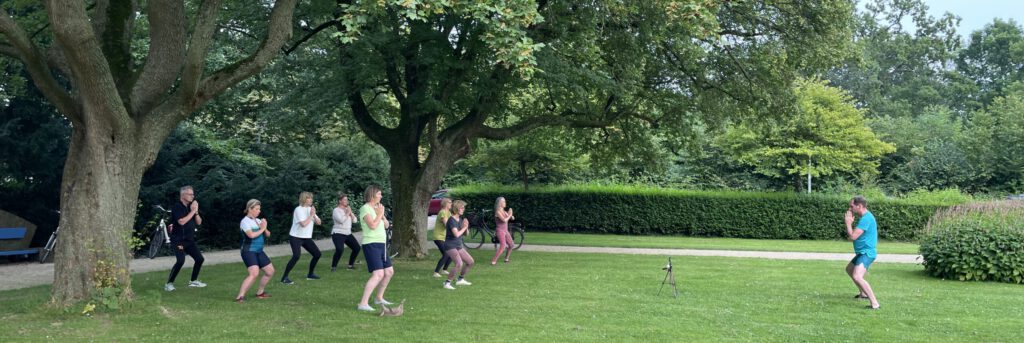
In the summer, classes take place in the park. These one-hour sessions are held without yoga mats. It’s helpful if you have kung fu shoes, but of course it’s not required. Being outdoors can make us more easily distracted, but we still aim to connect deeply with ourselves through Qi Gong and Tai Chi exercises. Just like on a mat, the movements are performed standing, guided by the hara and the heart, and in principle have the same effect as a yoga class on a mat in the studio.
Livestream classes
We recommend using a thick yoga mat and yoga blocks that you can sit on, as well as a PC, phone, or iPad to follow the class.
The classes can be followed online via Google Classroom. Once you let us know that you would like to participate, we will send you an email address and password so you can always log in to the virtual classroom. During the class, you can message or call our mobile number at any time for assistance. You can find a detailed description here.
Literature
If you would like to learn more about yoga and the practice we offer at our yoga school, we recommend the following books from our reading list.
Would you like to join us for a class. Just give us a call, WhatsApp or send us a mail for a free trial.
read more
Roads were made for journeys, not for destinations – Confucius